Question 4 (a)
The shut-down point of a perfectly competitive firm
9 marks
- Time to write
- About 18 minutes
Question
Question 4 (a) · 9 marksExplain what is meant by the shut-down point of a perfectly competitive firm. In the short run, under what condition does a perfectly competitive firm shut down? Explain with the help of a diagram.
Reworded from the university paper; the task is the same. The original paper belongs to the University of Delhi. See DU's question bank.
Before you write
Read off the question and its marks
Read from the question
- Explain…What…?3 questions in all: answer every one.
- diagramDraw the diagram, and label both axes and every curve.
Write it in this order
- Read; underline the asks; jot your points 1 min
- 1 Price taking and P = MC 1 mark 2 min
- 2 Concept of the shut-down point 2 marks 2 min
- 3 Short-run shut-down condition, with the three price cases 3 marks 6 min
- 4 Diagram and conclusion 3 marks 6 min
- Check: every ask answered, key terms underlined 1 min
Easy marks
- Concept of the shut-down point (step 2, 2 marks): a clear definition and a line on what it covers. A minute or two.
Short on time? Keep step 2 short. Trim steps 3 and 4 evenly rather than skip one: each is capped at its own marks.
Try it first. About 18 minutes for 9 marks. Write it out, then open the solution.
Solution
Hover or tap a marked figure, like 72,000, to see how it is made and where else it appears.
Short-run equilibrium of a competitive firm
A perfectly competitive firm is a price taker: it can sell any quantity at the market price, so price = average revenue = marginal revenue, and its demand curve is a horizontal line at that price. It maximises profit (or minimises loss) by producing where price equals marginal cost (P = MC) on the rising part of the MC curve. In the short run the firm has fixed costs (rent, interest, salaried staff) that it must pay whether it produces or not, and variable costs (raw material, wages, power) that it incurs only if it produces.
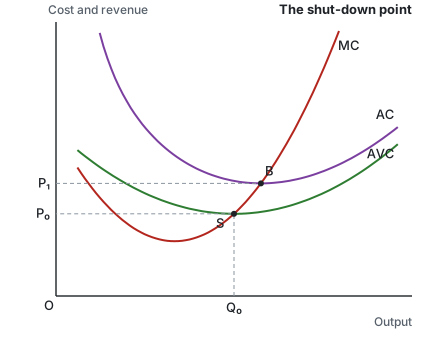
The shut-down point is the output and price at which the firm is just indifferent between producing and closing down temporarily. It lies at the minimum point of the average variable cost (AVC) curve, where the MC curve cuts AVC from below. At that price:
- revenue (P × Q) exactly covers total variable cost;
- the loss from producing equals the total fixed cost, which is the same loss the firm would make by shutting down.
When the firm shuts down in the short run
Compare the loss from producing with the loss from shutting down (the fixed cost):
- P ≥ minimum AC. The firm covers all costs and earns normal or supernormal profit; it produces where P = MC.
- Minimum AVC < P < minimum AC. The firm makes a loss, but revenue covers all variable cost and part of the fixed cost. Producing loses less than closing, so it continues in the short run. At P = minimum AVC exactly, revenue covers variable cost only and the firm is indifferent between producing and closing (the shut-down point).
- P < minimum AVC. Revenue does not even cover variable cost; each unit produced adds to the loss. The firm shuts down and loses only its fixed cost.
The condition for shutting down in the short run is therefore: price below minimum average variable cost (equivalently, total revenue less than total variable cost).
Diagram. Output on the horizontal axis, cost and revenue on the vertical axis. U-shaped AC and AVC curves (AVC below AC, the gap between them being average fixed cost) and an MC curve cutting both at their minimum points. The minimum of AVC is point S, at price OP₀ and output OQ₀: the shut-down point. The minimum of AC is point B at price OP₁: the break-even point. A price line above OP₁ gives profit; a price line between OP₀ and OP₁ gives a loss but the firm continues; a price line below OP₀ makes the firm close. The firm's short-run supply curve is the MC curve from S upward.
Example (our own). A small rice mill in Punjab with fixed rent and loan interest keeps milling during a dull season if the price of rice still covers paddy, wages and power per quintal, even though the rent is not fully recovered. If the price falls below that, it stops milling until prices recover, losing only its rent and interest.
The shut-down point is the minimum of AVC. In the short run a competitive firm keeps producing as long as price covers average variable cost, because fixed costs have to be paid anyway, and closes when price falls below minimum AVC. In the long run, by contrast, it must cover all costs or leave the industry.
Where the 9 marks sit
| # | Component | Marks |
|---|---|---|
| 1 | Price taking and P = MC | 1 |
| 2 | Concept of the shut-down point | 2 |
| 3 | Short-run shut-down condition, with the three price cases | 3 |
| 4 | Diagram and conclusion | 3 |
| Total | 9 |
Report a problemopens an email to admin@getkunji.com with the question ID7506-Q4aalready filled in.