Question 4 (d)
Features of oligopoly and the reasons for price rigidity
9 marks
- Time to write
- About 18 minutes
- Topic
- Oligopoly
Question
Question 4 (d) · 9 marksDiscuss the features of an oligopolistic market structure. Why does price rigidities arise in an oligopolistic market? Explain with the help of diagram.
Reworded from the university paper; the task is the same. The original paper belongs to the University of Delhi. See DU's question bank.
Before you write
Read off the question and its marks
Read from the question
- Discuss…Why…?Explain…3 asks, each with its own marks below. Answer all 3. Where it asks why, give reasons, not a description.
- diagramDraw the diagram, and label both axes and every curve.
Write it in this order
- Read; underline the asks; jot your points 1 min
- 1 Features of oligopoly 3 marks 5 min
- 2 Reasons for price rigidity 2 marks 4 min
- 3 Kinked demand curve with diagram 4 marks 7 min
- Check: every ask answered, key terms underlined 1 min
Short on time? Trim steps 1–3 evenly rather than skip one: each is capped at its own marks.
Try it first. About 18 minutes for 9 marks. Write it out, then open the solution.
Solution
Hover or tap a marked figure, like 72,000, to see how it is made and where else it appears.
- Few large sellers. A small number of firms supply most of the market, as in Indian telecom services, cement, aviation or soft drinks.
- Interdependence. Each firm's sales and profit depend on what its rivals do, so every price or output decision must anticipate their reaction. This is the defining feature.
- Barriers to entry. Large capital needs, economies of scale, patents, licences, control of distribution and established brands keep new firms out.
- Homogeneous or differentiated products. Pure oligopoly sells an almost identical product (steel, cement); in differentiated oligopoly products differ (cars, smartphones).
- Indeterminate demand curve. A firm cannot know the demand curve for its own product without knowing how rivals will respond to its price changes.
- Non-price competition and selling costs. Firms compete through advertising, product features, service and offers rather than price.
- Group behaviour and collusion. Firms may follow a price leader, form cartels or reach informal understandings.
- Price rigidity. Prices, once set, tend to stay unchanged for long periods even when costs change.
Why prices are rigid in oligopoly
- Fear of a price war: a price cut may be matched and lead to a series of cuts that hurts all firms.
- Asymmetric reactions of rivals: rivals match a price cut but ignore a price rise (the kinked demand curve below).
- Tacit understanding: firms prefer stable prices and compete in other ways.
- Costs of changing prices: reprinting price lists and renegotiating contracts make frequent changes costly.
Paul Sweezy's kinked demand curve explains the rigidity through the asymmetric reaction of rivals.
Assumption. The ruling price is OP. If one firm raises its price above OP, rivals do not follow, so it loses many customers: demand above OP is elastic. If it cuts price below OP, rivals match the cut to protect their shares, so it gains few customers: demand below OP is inelastic.
Diagram. Output on the horizontal axis, price and cost on the vertical axis. The demand curve dKD has a kink at K (price OP, output OQ): the upper segment dK is flat (elastic) and the lower segment KD is steep (inelastic). Because the two segments have different slopes, the marginal revenue curve has a vertical gap AB directly below K: MR jumps down from A (end of the MR for dK) to B (start of the MR for KD).
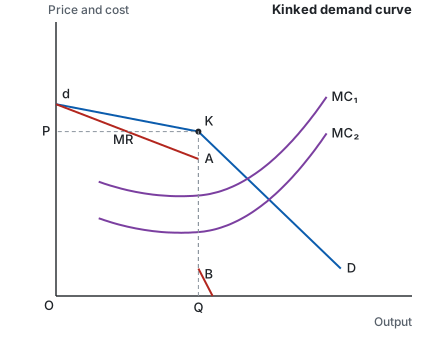
Result. The firm maximises profit where MC passes through the gap AB. If costs rise or fall (MC moves from MC₁ to MC₂) but stay within the gap, the profit-maximising output stays OQ and the price stays OP. Prices therefore remain unchanged over a range of cost changes: price rigidity.
Limitations. The model explains why a price, once set, stays put, but not how the price OP was set in the first place, and it assumes that rivals will not follow a price rise. That assumption is weakest when costs rise for every firm at once, as in general inflation, since each rival then has its own reason to raise its price too.
Oligopoly is marked by few sellers, interdependence, entry barriers and non-price competition. Prices are rigid because rivals match cuts but not rises, which gives a kinked demand curve and a gap in marginal revenue within which cost changes leave price and output unchanged.
Where the 9 marks sit
| # | Component | Marks |
|---|---|---|
| 1 | Features of oligopoly | 3 |
| 2 | Reasons for price rigidity | 2 |
| 3 | Kinked demand curve with diagram | 4 |
| Total | 9 |
Report a problemopens an email to admin@getkunji.com with the question ID7506-Q4dalready filled in.