Question 5 (a)
How firms adjust to long-run equilibrium under perfect competition
9 marks
- Time to write
- About 18 minutes
Question
Question 5 (a) · 9 marks"Under perfect competition, firms go through a process of adjustment to reach long-run equilibrium". Discuss this statement, using a suitable diagram.
Reworded from the university paper; the task is the same. The original paper belongs to the University of Delhi. See DU's question bank.
Before you write
Read off the question and its marks
Read from the question
- DiscussTie the answer to the quoted statement: say what it means first, and come back to it at the end.
- diagramDraw the diagram, and label both axes and every curve.
- processA process: the steps in order, one heading each.
Write it in this order
- Read; underline the asks; jot your points 1 min
- 1 Meaning of the statement and the short-run position 2 marks 4 min
- 2 The adjustment through entry, exit and plant size 3 marks 5 min
- 3 Long-run equilibrium conditions with the two-panel diagram 4 marks 7 min
- Check: every ask answered, key terms underlined 1 min
Easy marks
- Step 1 opens with the meaning: a one-line definition, the quickest mark in it.
Short on time? Trim steps 1–3 evenly rather than skip one: each is capped at its own marks.
Try it first. About 18 minutes for 9 marks. Write it out, then open the solution.
Solution
Hover or tap a marked figure, like 72,000, to see how it is made and where else it appears.
Under perfect competition (many sellers of a homogeneous product, free entry and exit, perfect knowledge and mobility), the short-run position of firms need not last. In the long run firms can change their plant size and can enter or leave the industry. The statement means that these adjustments continue until no firm has a reason to change, which happens only when every firm earns exactly normal profit at the minimum of its long-run average cost.
In the short run the number of firms and their plants are fixed. The market price is set by industry demand and supply, and each firm produces where P = MC. Depending on the price, a firm may earn supernormal profit (P > SAC), normal profit (P = SAC) or a loss (P < SAC, but P ≥ AVC).
- Losses drive firms out. Where the price is below average cost, firms cannot cover their costs; some close down and others cut back their plants. With fewer firms the industry supply curve moves left and the price climbs.
- Supernormal profit draws firms in. Where the price OP₁ is above average cost, the extra profit tempts newcomers, who are free to enter, and existing firms enlarge their plants. The industry supply curve moves right, from S₁ to S₂, and the price comes down.
- Plant size adjusts. Each firm that stays moves along its long-run average cost curve to the plant that gives its output at the least cost, towards the curve's lowest point.
- Adjustment ends once the price settles where firms earn just normal profit, neither more nor less, so nobody has a reason to come in or go out.
Diagram (two panels).
- Industry panel: market demand DD and supply S₁ give the initial price OP₁. Entry shifts supply to S₂, and the price falls to OP*.
- Firm panel: the firm's U-shaped LAC and LMC curves with SAC and SMC of the optimal plant. At OP₁ the firm's price line lies above its average cost (shaded supernormal profit). At OP* the horizontal price line (AR = MR) just touches the minimum point E of LAC, where SAC, SMC and LMC also pass. The firm produces OQ*.
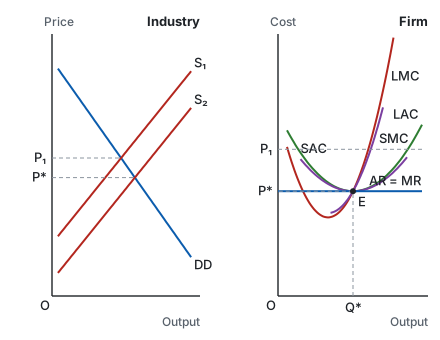
At the final position E, for every firm:
P = AR = MR = SMC = LMC = SAC = LAC (minimum)
- P = MC, with MC rising at that output (LMC cuts the price line from below): each firm maximises profit.
- P = minimum LAC: only normal profit; no entry or exit.
- Firms work the optimum plant at the optimum scale, so output is produced at the lowest possible average cost and there is no excess capacity.
Example (our own). When small dairies in a district earn high profits from paneer, new units open and existing ones add capacity; paneer prices fall until a typical unit just covers its full cost, after which entry stops.
Supernormal profits and losses are short-run phenomena under perfect competition. Entry and exit, and the choice of plant size, shift industry supply until the price equals minimum long-run average cost. In long-run equilibrium every firm earns normal profit and produces at the lowest point of its LAC, the most efficient scale.
Where the 9 marks sit
| # | Component | Marks |
|---|---|---|
| 1 | Meaning of the statement and the short-run position | 2 |
| 2 | The adjustment through entry, exit and plant size | 3 |
| 3 | Long-run equilibrium conditions with the two-panel diagram | 4 |
| Total | 9 |
Report a problemopens an email to admin@getkunji.com with the question ID7506-Q5aalready filled in.