Question 2 (c)
Budget line: intercepts, slope, equation and equilibrium
9 marks
- Time to write
- About 18 minutes
Question
Question 2 (c) · 9 marksTake the price of good X as ₹4 per unit and the price of goods Y as ₹8 per unit, and the monetary income as ₹96. You are asked to:
Calculate the intercept and slope
Write the budget equation.
Show the equilibrium and comment on it.
What is the slope of the indifference curve at the equilibrium point on this budget line.
Reworded from the university paper: names and figures differ, the task is the same. The original paper belongs to the University of Delhi. See DU's question bank.
Before you write
Read off the question and its marks
Read from the question
- Calculate…Write…Show…3 questions in all: answer every one.
- and comment onThe comment carries marks too: say what the figures show, in two or three lines.
- CalculateFormula first, then the working, then the answer with its unit (₹, %, units).
Write it in this order
- Read the data; note exactly what is asked 1 min
- 1 Intercepts and slope 2 marks 4 min
- 2 Budget equation 2 marks 4 min
- 3 Equilibrium shown and commented on 3 marks 5 min
- 4 Slope of the indifference curve at equilibrium 2 marks 3 min
- Check: arithmetic, units (₹, %), final answer underlined 1 min
Try it first. About 18 minutes for 9 marks. Write it out, then open the solution.
Solution
Hover or tap a marked figure, like 72,000, to see how it is made and where else it appears.
Data: price of X, Pₓ = ₹4; price of Y, Pᵧ = ₹8; money income M = ₹96. X is measured on the horizontal axis and Y on the vertical axis.
- Intercept on the X-axis = M ÷ Pₓ = 96 ÷ 4 = 24 units of X (all income spent on X).
- Intercept on the Y-axis = M ÷ Pᵧ = 96 ÷ 8 = 12 units of Y (all income spent on Y).
- Slope of the budget line = −Pₓ ÷ Pᵧ = −4 ÷ 8 = −0.5. Equivalently, −(Y-intercept ÷ X-intercept) = −12 ÷ 24 = −0.5. The market lets the consumer exchange 1 unit of X for 0.5 unit of Y: buying one more unit of X means giving up half a unit of Y.
Pₓ·X + Pᵧ·Y = M, that is 4X + 8Y = 96, or, dividing by 4, X + 2Y = 24. Solved for Y: Y = 12 − 0.5X, a straight line with vertical intercept 12 and slope −0.5.
Check of points on the line: (24, 0) costs 4 × 24 = ₹96; (0, 12) costs 8 × 12 = ₹96; (8, 8) costs 4 × 8 + 8 × 8 = 32 + 64 = ₹96.
Diagram. Draw the budget line AB from A (0, 12) on the Y-axis to B (24, 0) on the X-axis, and an indifference map of convex curves. The consumer's equilibrium is at E, where AB is tangent to the highest attainable indifference curve, say IC₂. Lower curves such as IC₁ cut AB at two points, so the consumer can do better by moving along AB towards E; higher curves such as IC₃ lie wholly outside AB and cannot be reached.
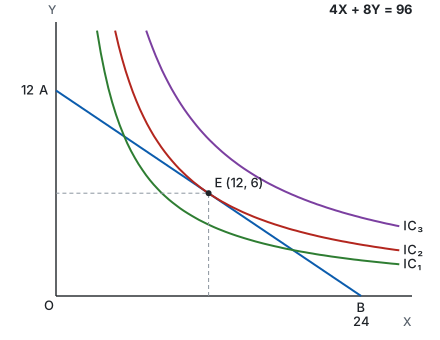
Comment.
- At E the consumer spends the whole ₹96 and reaches the highest satisfaction possible with this income and these prices.
- At E the slope of the indifference curve equals the slope of the budget line: MRSₓᵧ = Pₓ/Pᵧ = 0.5.
- The exact bundle at E depends on the consumer's preferences, which the question does not give. For illustration, if the consumer spends equal amounts on the two goods (₹48 each), E is at X = 48 ÷ 4 = 12 and Y = 48 ÷ 8 = 6; the bundle (12, 6) lies on the budget line, since 4 × 12 + 8 × 6 = 48 + 48 = ₹96.
- Any point inside AB leaves income unspent and cannot be an equilibrium for a consumer who prefers more to less.
(iv) Slope of the indifference curve at equilibrium
At the point of equilibrium the indifference curve is tangent to the budget line, so its slope equals the budget line's slope: −0.5. In other words, MRSₓᵧ = Pₓ/Pᵧ = 4/8 = 0.5: at E the consumer is willing to give up half a unit of Y for one more unit of X, exactly the rate the market offers.
The budget line 4X + 8Y = 96 has intercepts of 24 units of X and 12 units of Y and a slope of −0.5. Whatever the consumer's tastes, at equilibrium the indifference curve touches this line, so its slope there is also −0.5.
Where the 9 marks sit
| # | Component | Marks |
|---|---|---|
| 1 | Intercepts and slope | 2 |
| 2 | Budget equation | 2 |
| 3 | Equilibrium shown and commented on | 3 |
| 4 | Slope of the indifference curve at equilibrium | 2 |
| Total | 9 |
Report a problemopens an email to admin@getkunji.com with the question ID7506-Q2calready filled in.