Question 2 (d)
Lump-sum subsidy versus excise subsidy: a proof with indifference curves
9 marks
- Time to write
- About 18 minutes
Question
Question 2 (d) · 9 marksUsing budget line and indifference curve, prove that a government policy of lump-sum subsidy has a better effect on consumer welfare than excise subsidy.
Reworded from the university paper; the task is the same. The original paper belongs to the University of Delhi. See DU's question bank.
Before you write
Read off the question and its marks
Read from the question
- prove thatThe result is given: the marks are for the steps that reach it.
Write it in this order
- Read; underline the asks; jot your points 1 min
- 1 The two policies and the equal-cost condition 2 marks 4 min
- 2 Proof with budget lines and indifference curves diagram 5 marks 9 min
- 3 Reasons and conclusion 2 marks 3 min
- Check: every ask answered, key terms underlined 1 min
Short on time? Trim steps 1–3 evenly rather than skip one: each is capped at its own marks.
Try it first. About 18 minutes for 9 marks. Write it out, then open the solution.
Solution
Hover or tap a marked figure, like 72,000, to see how it is made and where else it appears.
Suppose the government wants to help a consumer and is willing to spend the same amount of money either way.
- An excise (price) subsidy pays part of the price of one good, X, for every unit bought (for instance, a subsidy of ₹s per kg of a food item). The consumer's effective price of X falls from Pₓ to Pₓ − s.
- A lump-sum (income) subsidy gives the consumer a fixed sum of money, which she may spend as she likes. Prices are unchanged; only her income rises.
The claim is that, for the same cost to the government, the lump-sum subsidy leaves the consumer on a higher (or at least as high) indifference curve.
Proof with budget lines and indifference curves
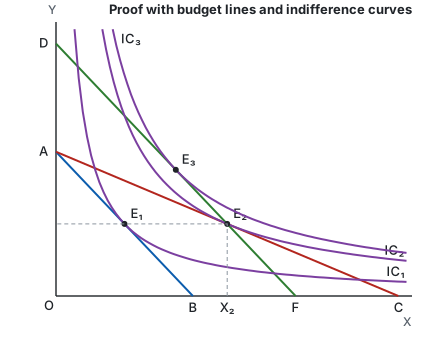
Diagram. X on the horizontal axis, Y (all other goods, measured in money) on the vertical axis.
- Before any subsidy. The budget line is AB, with slope −Pₓ/Pᵧ. The consumer is in equilibrium at E₁ on IC₁.
- Excise subsidy. The price of X falls to Pₓ − s, so the budget line rotates outward about A to AC (flatter). The consumer moves to E₂ on the higher curve IC₂, buying OX₂ units of X. At E₂ the slope of IC₂ equals the new, flatter price ratio: MRSₓᵧ = (Pₓ − s)/Pᵧ.
- Cost of the excise subsidy. The government pays s on each of the OX₂ units bought. In the diagram this cost is the vertical distance, at OX₂, between the subsidised line AC and the original line AB (that is, the distance from E₂ down to AB), measured in units of Y.
- Lump-sum subsidy of the same cost. Give the consumer that same sum as income. Her budget line shifts outward parallel to AB (the original slope −Pₓ/Pᵧ, since prices are unchanged) by exactly that distance. This new line, DF, therefore passes through E₂: with the cash she could still buy the bundle E₂.
- Comparison. At E₂ the indifference curve IC₂ is flatter than DF, because MRSₓᵧ = (Pₓ − s)/Pᵧ is less than Pₓ/Pᵧ. So IC₂ cuts DF at E₂ rather than touching it. Part of DF (to the left of E₂, with less X and more Y) lies above IC₂. Moving along DF from E₂ towards those bundles, the consumer reaches a higher indifference curve, IC₃, at a new tangency E₃ where MRSₓᵧ = Pₓ/Pᵧ.
Since E₃ on IC₃ is preferred to E₂ on IC₂, the lump-sum subsidy gives more satisfaction for the same government outlay.
Why the lump-sum subsidy does better
- The excise subsidy changes relative prices. It induces the consumer to buy more X than she would choose if she simply had the money, so part of the subsidy is spent on extra units of X that she values at less than their true cost.
- The lump-sum subsidy leaves relative prices alone and lets her spend the extra income on the mix she prefers, so no satisfaction is lost through distorted choices.
- The two give equal satisfaction only when the consumer reaches the same indifference curve under both, which happens when the price subsidy brings no substitution towards the subsidised good (for instance with perfect complements, L-shaped indifference curves); otherwise the lump-sum subsidy puts her on a higher curve. It is never worse.
For the same cost to the government, a lump-sum subsidy puts the consumer on IC₃, above the IC₂ reached under an excise subsidy, so it has the better effect on welfare. The excise subsidy is still used when the government wants to raise consumption of a particular good (food, cooking gas, fertiliser), accepting some loss of consumer welfare to achieve that aim.
Where the 9 marks sit
| # | Component | Marks |
|---|---|---|
| 1 | The two policies and the equal-cost condition | 2 |
| 2 | Proof with budget lines and indifference curves (diagram) | 5 |
| 3 | Reasons and conclusion | 2 |
| Total | 9 |
Report a problemopens an email to admin@getkunji.com with the question ID7506-Q2dalready filled in.